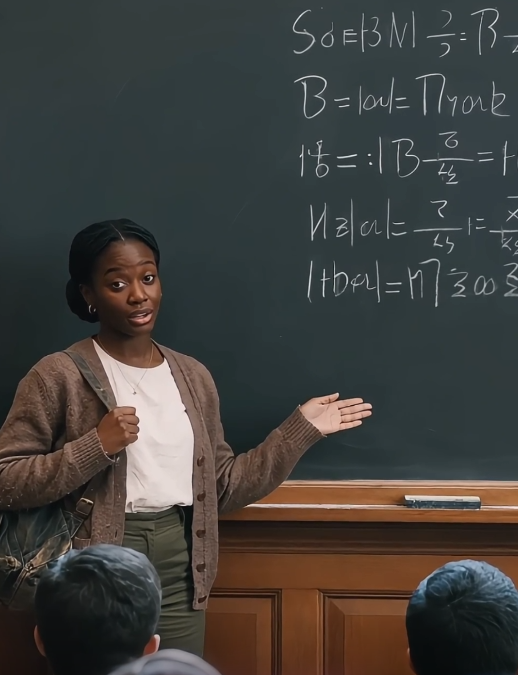
“Excuse me, professor, but I believe line three is wrong,” Celeste said quietly, raising her hand inside the crowded lecture hall.
Professor Whitfield slowly turned toward her. “What did you just say?” His voice carried through the room, making everyone suddenly uncomfortable.
“The sign is incorrect, sir,” Celeste answered. “That mistake collapses the entire proof.” Whitfield stared at her cracked tablet and laughed.
“You are correcting me?” he sneered. “Look at you. You smell like a Greyhound bus. Who even let you inside?”
Celeste stood calmly. “I can show you exactly where the proof breaks.” Whitfield pointed toward her chair. “Sit down. This is Harvard, not a charity shelter.”
Nobody defended her. Students lowered their eyes while Whitfield continued explaining his theorem, completely unaware that Celeste had already solved something nobody else could.
Celeste had traveled from Anacostia that morning with a cracked tablet, one bus ticket, and exactly enough money for a sandwich.
She wasn't supposed to be there as a Harvard student. She had entered the lecture because a professor had recommended her for an elite mathematics competition.
Whitfield was tenured, celebrated, and untouchable. The lecture series even carried his family name, making his authority seem almost impossible to challenge.
When the competition began, Whitfield smiled confidently. “Let us see which university produces the greatest mathematical mind in America.”
Round one started, and within minutes, Celeste placed her pencil down. “I'm finished.” The judges exchanged confused glances.
A competitor whispered, “Already?” Celeste simply nodded. When the results appeared, she had finished first by an astonishing margin.
Round two presented a complicated statement. Everyone began calculating furiously while Celeste stared silently at the board.
After several seconds, she drew six small dots and said, “The statement is false.” Whitfield immediately snapped, “Prove it.”
Celeste pointed toward the diagram. “These six points create a counterexample. The theorem fails under the fourth condition.” Three competitors stopped writing.
The room erupted with whispers. Phones appeared everywhere, but this time nobody was laughing at Celeste. They were recording her.
Whitfield's expression hardened. “Interesting. But the final round will separate talent from luck.” Celeste looked at him. “Then let's finish.”
The final problem appeared, taken from Whitfield's unpublished research. Graham, his favorite student, already knew the technique.
The clock started. Graham immediately wrote three pages while Celeste remained motionless. Someone whispered, “She's finally beaten.”
Sixty seconds remained. Celeste suddenly erased everything and began writing rapidly. “What is she doing?” a judge whispered.
The buzzer sounded. Whitfield stepped toward her board and smiled. “Incomplete. I'm afraid your performance ends here.” Celeste said nothing.
Then Dr. Calloway from Princeton stood up. “Move aside, Whitfield.” The professor stared at him. “Excuse me?” Calloway repeated, “I said move.”
Calloway traced every line with his finger. “This proof is complete. More importantly, I've never seen anything this elegant under competition conditions.”
Celeste reached into her bag and produced two documents. “There is something else you should examine.” Whitfield's face suddenly changed.
“These formulas came from your private research,” she said. “But the original timestamps prove they were altered after I submitted my solution.”
The judges examined the evidence. Dr. Calloway looked at Whitfield. “You manipulated the competition.” Whitfield shouted, “That's absurd!”
Then Celeste revealed the final document. “And seven points were removed from my first-round score before publication.” The room fell completely silent.
An investigation began immediately. Within weeks, Whitfield lost his title, his lecture series, and the reputation he had spent decades building.
Three universities offered Celeste full scholarships. Harvard finally offered her admission, but she politely declined. “I don't want to study somewhere that needed proof of my worth.”
She chose MIT instead, because they had believed in her before seeing the headlines, the scores, or the cameras.
Months later, Whitfield approached her outside a courthouse. “Celeste, I destroyed your opportunity.” She looked at him calmly. “No, professor. You revealed why I deserved it.”
Whitfield lowered his head. “Can you forgive me?” Celeste paused before answering, “I forgive you. But forgiveness doesn't erase consequences.”
Years later, Celeste returned to Harvard as a visiting professor. The same lecture hall was packed, but this time everyone stood when she entered.
She walked to the board, picked up a piece of chalk, and smiled. “Today, professor Whitfield's old theorem will be discussed.” The audience held its breath.
Celeste wrote one equation and turned around. “And before we begin, remember this: a wrong assumption can destroy a proof, but arrogance can destroy an entire career.”
The room erupted in applause. Celeste smiled quietly, remembering the girl with the cracked tablet and bus ticket who had once been told she didn't belong.
She had never needed Harvard to validate her brilliance. She had only needed one chance to prove that the person they underestimated was the person they should have listened to.