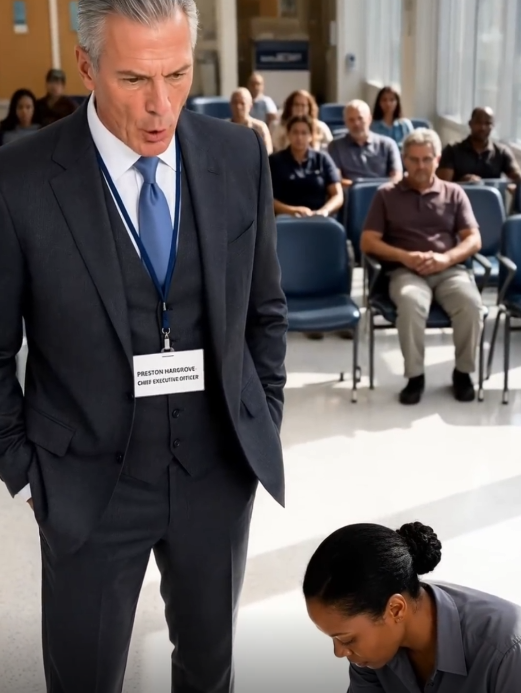
“Get your filthy hands off my patient! Who gave you permission to touch him?” Dr. Richard Cole shouted across the hospital lobby.
“Sir, he’s in critical condition,” Becky replied, kneeling beside the unconscious man while blood continued spreading across his clothing.
“You are not a nurse here,” Richard snapped. “You work sanitation. Step away before you make this situation worse.”
“The pen is already in his leg,” Becky said. “He was losing blood, and nobody else was helping him.”
Richard pointed toward the hallway. “Then let him die. That is not your job. You clean floors. You touch surfaces, not people.”
Becky stared at him. “Sir, I handed the emergency kit to the nurse because he was turning blue. I couldn’t just stand there.”
“Did I ask you for a statement?” Richard shouted. “One more word, and you’ll be pushing a cleaning cart somewhere else.”
Twenty people stood nearby watching the confrontation. Some looked uncomfortable, while others stared at their phones, recording every second.
Becky looked back at the dying patient. “My conscience won’t allow me to watch a man die simply because nobody has arrived.”
Richard’s face hardened. “Someone like you dares use the word conscience around me?” He turned toward two security officers.
“Hold her down,” Richard ordered. “I’m teaching this one a lesson. Get her out of here and call the police.”
Becky struggled against the officers. “Please, listen! His blood pressure is falling. If you move him incorrectly, he could die.”
Richard sneered. “She practiced medicine in my lobby. Arrest her for interfering with medical personnel.”
Then a nurse suddenly shouted, “Wait! Doctor, look at his monitor!” The patient’s oxygen level had begun climbing.
Everyone turned toward Becky. The emergency device she had retrieved was working exactly as intended.
The nurse stared at the patient. “His pulse is stabilizing.” Richard looked confused. “That’s impossible. He should have been transported upstairs immediately.”
Becky pointed toward the patient’s leg. “The object is controlling the bleeding. Removing it now could cause catastrophic blood loss.”
Richard stepped closer. “How would a sanitation worker know that?” Becky remained silent.
A senior emergency physician rushed into the lobby. “Who stabilized this patient?” The nurse pointed toward Becky.
The physician stared at her uniform. “You did this?” Becky nodded. “I followed the emergency protocol I learned years ago.”
Richard interrupted angrily. “She isn’t medically certified here.” The physician looked at Becky. “Where did you train?”
Becky hesitated. “I was a trauma nurse for twelve years before leaving medicine to care for my father.”
The physician’s expression changed instantly. “Why did you leave?” Becky answered, “He had dementia. Someone had to stay with him.”
Richard stared at her. “You were a nurse?” Becky nodded. “I never told anyone because I was hired for sanitation, and I needed the job.”
The emergency physician looked toward Richard. “You nearly removed the one person who understood exactly what was happening.”
Richard became defensive. “She violated hospital policy.” The physician answered, “Your policy doesn’t excuse watching a patient die.”
Then the hospital director arrived after receiving multiple calls about the incident. “What happened here?” Richard started explaining, but the nurse interrupted.
“This doctor ordered security to remove the woman who stabilized the patient,” she said. “We have twenty witnesses and several recordings.”
The director turned toward Becky. “Did you administer treatment?” Becky shook her head. “No. I recognized the emergency and gave the medical team what they needed.”
The director looked at Richard. “And you ordered her detained?” Richard lowered his eyes. “I was protecting protocol.”
“No,” the director replied. “You were protecting your authority.” The lobby fell silent.
The patient was rushed into surgery and survived. Hours later, his family arrived and asked who had kept him alive.
The director pointed toward Becky. “That woman.” His wife immediately hugged Becky and whispered, “Thank you for saving him.”
Becky began crying. “I only did what anyone should have done.” The family shook their heads. “You did what everyone else was too afraid to do.”
Richard was placed on administrative leave pending an investigation. Security footage showed him repeatedly humiliating staff and ignoring previous complaints.
The hospital uncovered seven reports describing similar behavior. Nurses had been threatened, cleaning staff had been intimidated, and emergency concerns had been dismissed.
Two weeks later, the hospital offered Becky a position in emergency services. She initially refused, saying, “I haven’t worn a nurse’s uniform in years.”
The medical director smiled. “Then perhaps it’s time you wore it again.” Becky accepted after one condition was approved.
“Every employee, regardless of job title, must be allowed to report a medical emergency without fear of retaliation,” she said.
The hospital director agreed and created a new emergency-response program involving cleaners, security officers, receptionists, and maintenance staff.
Months later, Becky stood before a training class and told new employees, “You never know when your moment to save someone will arrive.”
A young cleaner asked, “What if a doctor tells us to stay away?” Becky smiled. “Follow legitimate medical direction, but never ignore a life-threatening emergency.”
The patient Becky helped eventually returned to the hospital walking on his own. He carried a small framed photograph.
He handed it to Becky. “This is my family,” he said. “My wife wanted you to have it. She says you gave us another birthday together.”
Becky smiled through tears. “Then keep making memories. That’s the only thank-you I need.”
As she walked through the hospital later that evening, she passed the same lobby where everything had started.
A plaque now hung near the entrance: “Every person in this building has the power to make a difference.”
Becky stopped beneath it and smiled, remembering the moment someone told her, “You touch surfaces, not people.”
She whispered, “Sometimes one person is all it takes.”
And from that day forward, nobody in that hospital was treated as invisible again, because everyone finally understood that compassion has no job title.