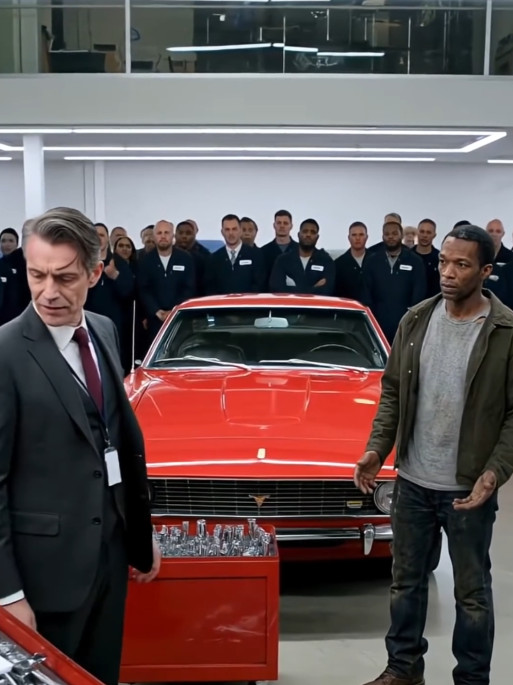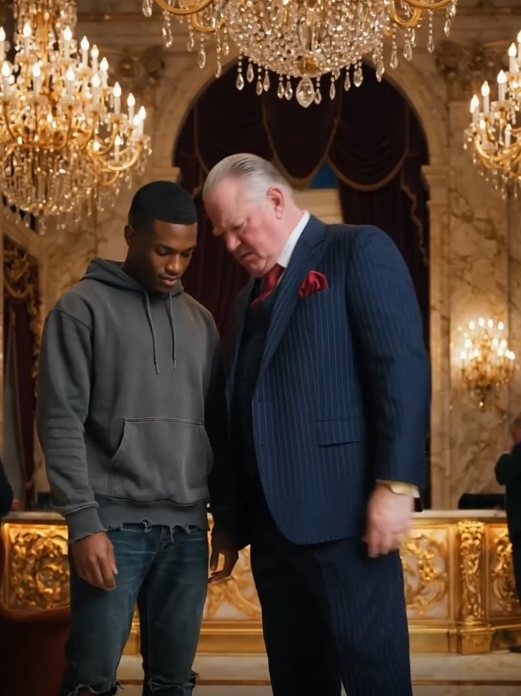
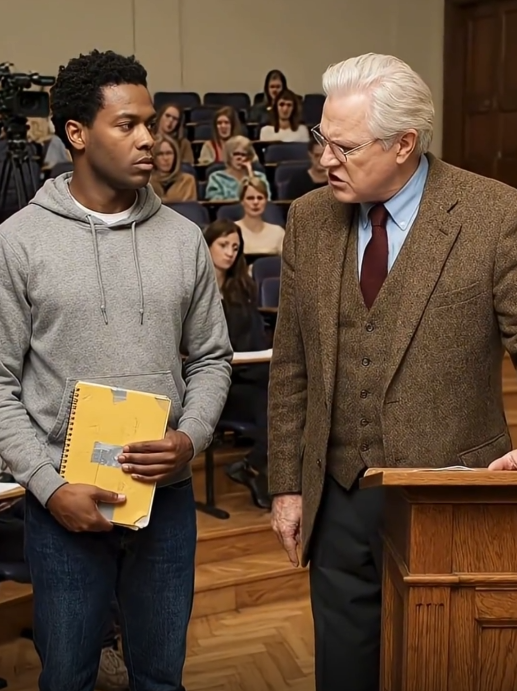
“Did you wander into the wrong building, schoolboy?” professor edward whitmore demanded, staring at the young man holding a taped notebook.
“No, sir,” caleb turner replied. “I came to fix your conjecture.” Whitmore laughed loudly. “Boy, you don’t fix anything here.”
“I understand, sir, but your bound on slide fourteen is wrong,” caleb said calmly. Hundreds of mathematicians turned toward him.
Caleb was twenty-five, had no university degree, and carried a yellow notebook held together with tape and years of handwritten calculations.
For thirteen years, he had studied mathematics in the back room of his father’s repair shop in akron, ohio, learning from borrowed books.
Whitmore had chaired harvard’s mathematics department for twenty-two years. His famous conjecture had resisted every serious attempt for half a century.
Whitmore snatched caleb’s notebook. “This is what you call mathematics?” He ripped two pages out and dropped them onto the floor.
Then he crushed the notebook’s cover beneath his polished shoe. “Go back to wherever you came from,” he said as three hundred people watched.
Caleb quietly knelt and collected every torn page. His hands never shook. He folded the pieces carefully and placed them inside his hoodie.
A graduate student whispered, “Why isn’t he angry?” Caleb simply walked to the back row and sat down without another word.
The lecture continued for almost an hour. Whitmore confidently presented his proof, displaying formulas that had impressed scholars around the world.
Then the question period began. Caleb slowly raised his hand. Whitmore noticed him and smiled sarcastically.
“Yes, the schoolboy,” Whitmore said. “Please enlighten us.” Caleb stood and approached the microphone.
“Your bound assumes uniform convergence,” Caleb explained, “but the function isn’t uniformly continuous at the boundary.”
The room became silent. Whitmore narrowed his eyes. “Are you challenging my published proof?” Caleb answered, “I’m saying your conclusion depends on an assumption that fails.”
Whitmore laughed. “Fine. Ten minutes at the blackboard.” The livestream audience surged as viewers waited for the humiliation he expected.
Caleb picked up the chalk and wrote three lines. “Here is the counterexample.” A freshman whispered, “That’s incredibly clean.”
On the second board, Caleb introduced a lemma that compressed three pages of standard work into two lines.
A graduate student stood suddenly. “Wait. That lemma changes the entire argument.” Whitmore stopped smiling.
Caleb continued to the third board. “The boundary problem disappears if we use this identity.”
Forty thousand people watched the livestream as Caleb filled the board with symbols. Whitmore’s hands began trembling.
His associate suddenly interrupted. “This resembles a chinese paper published years ago. He could have copied it.” The room erupted with accusations.
Caleb lowered the chalk. “I didn’t copy anything.” Whitmore pointed toward him. “Then explain where this came from.”
Before Caleb could answer, a professor from princeton stood and pointed toward the projected paper.
“Everyone stop. Read footnote twelve.” The room turned toward the screen, suddenly silent.
The footnote read, “Special thanks to c. turner of ohio, whose correspondence inspired lemma three.”
Caleb looked down. Whitmore’s face became completely white. The associate whispered, “That’s impossible.”
The princeton professor demanded, “Who is c. turner?” Caleb answered quietly, “Me.” Several mathematicians stood in disbelief.
Whitmore stared at Caleb. “You’ve been corresponding with researchers?” Caleb nodded. “For years. Usually anonymously.”
Whitmore asked, “Why anonymously?” Caleb replied, “Because I wanted the mathematics judged before my background became part of the conversation.”
Caleb returned to the blackboard. “But there’s something else you should know.” Whitmore whispered, “What?”
“This conjecture wasn’t unsolved because nobody was smart enough,” Caleb said. “It was unsolved because the published formulation contains a hidden restriction.”
The room fell silent. Caleb explained that the original conjecture had been altered decades earlier, changing a boundary condition and making the statement appear impossible.
Whitmore stared at the old papers. “Who changed it?” Caleb pointed toward an archived manuscript displayed behind the stage.
“Professor whitmore,” Caleb said quietly. “Your predecessor changed the wording fifty-one years ago, and you inherited the altered version.”
The crowd gasped. Whitmore shook his head. “That cannot be true.” Caleb opened his yellow notebook.
Inside was the original formulation, copied from a private archive that had never been digitized.
A senior professor approached. “Where did you find this?” Caleb answered, “My father repaired equipment for the university archive years ago. I found the document in an abandoned storage box.”
The room erupted into whispers. The actual mathematical problem had been solvable for decades, but generations of researchers had unknowingly attacked the wrong version.
Caleb then completed the corrected proof in six additional lines. The final expression appeared on the board.
Whitmore stared at it for nearly a minute before whispering, “You solved fifty years of work.” Caleb shook his head.
“No,” Caleb replied. “I corrected the question. The answer was waiting underneath.”
Whitmore slowly approached him. “Why didn’t you embarrass me?” Caleb looked at the torn notebook inside his pocket.
“Because mathematics doesn’t become more beautiful when someone loses,” he said. “It becomes beautiful when everyone finally sees the truth.”
The auditorium erupted in applause. The same people who had watched Whitmore humiliate Caleb were now standing for him.
A week later, harvard offered Caleb a research position and a full scholarship, but he asked for something else first.
“I want an open fellowship for people without traditional degrees,” Caleb said. “Talent shouldn’t need permission from a résumé.”
Whitmore agreed, stepping away from the department chair position voluntarily after acknowledging the historical error publicly.
Years later, Caleb became one of the world’s most respected mathematicians. His yellow notebook remained in a glass case at harvard.
Beside it was a small plaque: “Knowledge does not care where you learned it. It only cares whether the proof is correct.”
And whenever students asked Caleb how he survived that first humiliation, he smiled.
“I picked up every torn page,” he said. “Because sometimes the papers people throw away are carrying the answer they were never willing to read.”