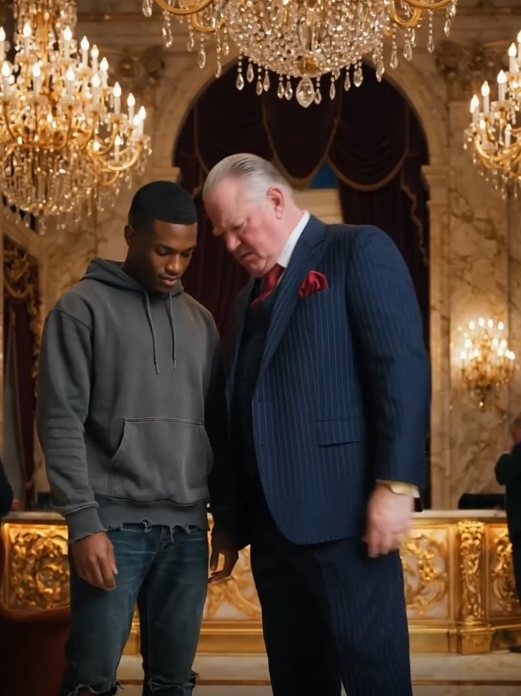
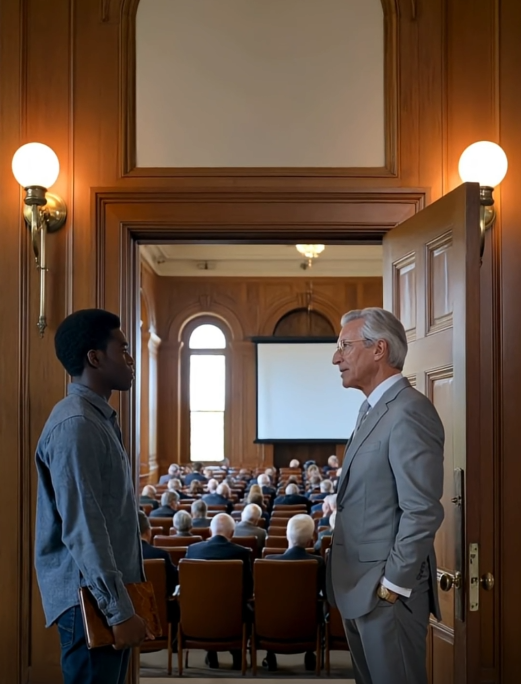
“Get out. This room has an IQ minimum, and you don't meet it,” Dr. Whittaker said, pointing toward the doors.
Wesley Davis stood quietly beside the entrance. “I only wanted to listen, sir.” Whittaker laughed. “You can barely read.”
“Security, who let this stray inside?” Wesley lowered his eyes. “I read your paper, Dr. Whittaker. All six of them.”
The laughter stopped. Whittaker leaned forward. “Then you should know this room isn't for boys from the gutter.”
Wesley swallowed. “Yes, sir. But your lemma 4.2 is wrong.” Thirty professors suddenly stopped breathing.
Nobody moved. Princeton, MIT, Oxford, and Stanford scholars stared at the twenty-year-old wearing a cheap flannel shirt.
Professor Brooks whispered, “Did that kid just challenge Whittaker?” Another professor answered, “He has no idea what he's talking about.”
Whittaker smiled coldly. “Prove it, boy. Or get off my stage.” Wesley looked at the enormous projector behind him.
The screen displayed the Caldwell-Rinehart conjecture, an unsolved mathematical problem that had defeated brilliant minds for forty years.
Whittaker had dedicated his entire career to that problem. Six papers, countless conferences, and decades of failed attempts followed.
Wesley had arrived after sixteen exhausting hours on a Greyhound bus, carrying two dollars and an old leather notebook.
His grandfather had given him that notebook shortly before dying. “Never rush mathematics,” Walter Davis had told him. “Let every symbol earn its place.”
Whittaker handed Wesley a piece of chalk. “You have twelve minutes. Impress us, or disappear.” Wesley nodded and faced the board.
He didn't write quickly. Every equation appeared slowly, carefully, as though he had already walked through the proof hundreds of times.
After twelve minutes, the front row stopped laughing. After twenty minutes, professors were copying Wesley's equations into their notebooks.
Then Brooks suddenly stood. “Wait. There's a sign error on line thirty-eight.” Several scholars smiled with relief.
Brooks pointed toward Wesley. “High school mistake. He's finished.” Wesley stared at the equation for several seconds.
“No,” Wesley whispered. “That's not the mistake. That's the key.” Brooks frowned. “What did you just say?”
Wesley erased three symbols and replaced them with a completely different transformation. The room became so quiet that the cameras captured every breath.
Margaret Caldwell, granddaughter of the conjecture's original creator, stepped closer. “He's not correcting the error. He's using it.”
Whittaker's expression changed. “Stop.” Wesley continued writing. “Please, let him finish,” Margaret whispered.
Eighteen minutes later, Wesley stepped backward and placed the chalk on the tray. Three letters remained on the board.
Q.E.D. Nobody applauded. Thirty professors simply stared at the proof as though reality itself had shifted.
The livestream counter climbed past one hundred fifty-six thousand viewers. Wesley turned around and quietly asked, “Is it correct?”
Whittaker approached the board. He read the proof once. Then twice. His hands began trembling.
“Where did you learn this?” Whittaker finally asked. Wesley answered, “My grandfather taught me everything I know.”
“Walter Davis?” Whittaker's voice cracked. Wesley nodded. “He spent thirty years solving this in a railroad toolshed.”
Margaret looked stunned. “Your grandfather was fired from the railroad because of discrimination?” Wesley nodded silently.
“He never stopped working,” Wesley said. “He believed mathematics couldn't see skin color, only whether the answer was true.”
Suddenly, the symposium screen changed. A live call from Princeton appeared. “We need to speak with Wesley Davis immediately.”
Whittaker stepped aside. “Young man, Princeton wants to offer you a full scholarship, research position, and access to every resource available.”
Wesley looked at the old notebook in his hands. “Can I bring my grandfather's work with me?”
The Princeton representative smiled. “Not only can you bring it. We want to preserve it under his name.”
For the first time that day, Wesley smiled. “Then I accept.” The audience finally erupted into thunderous applause.
Years later, Wesley became the youngest professor in Princeton's mathematics department and completed dozens of problems previously considered impossible.
But he never forgot that stage, the laughter, or the professor who told him he didn't belong.
At his first major lecture as a professor, Wesley noticed a nervous young student sitting alone in the back.
The student wore worn clothes and clutched a battered notebook. Wesley smiled and said, “Come closer. The front row is for anyone willing to learn.”
The student hesitated. “Are you sure I belong here?” Wesley remembered his grandfather and answered, “If you have a question, you already belong.”
Then Wesley wrote one sentence across the board: “Talent has no uniform, and genius does not ask permission.”
The room applauded, but Wesley simply touched his grandfather's notebook and whispered, “We finished it, grandpa.”