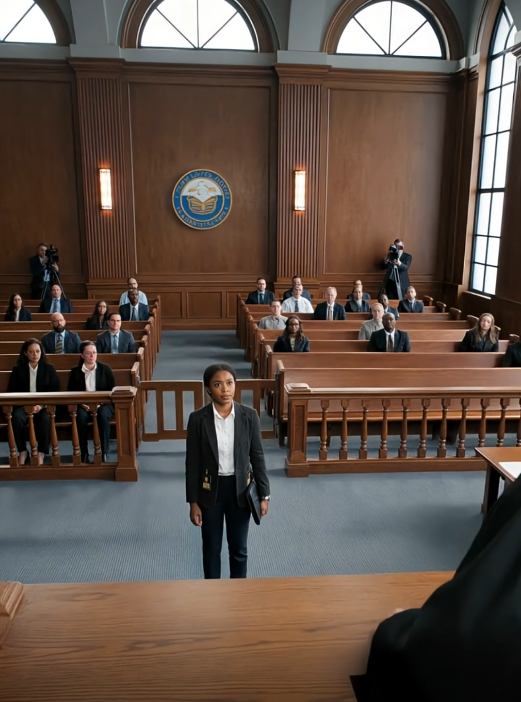
“Sit down,” the judge snapped. Renee remained standing, clutching a thin folder while two hundred people watched the courtroom suddenly fall silent.
“Your honor, I have the right to speak,” Renee answered. The judge laughed coldly and pointed toward her inexpensive blazer.
“You’re an intern, a nobody. You don’t speak in my courtroom.” Renee swallowed her anger and quietly replied, “Then let the evidence speak.”
The judge leaned forward. “Look at you. Thirty-dollar blazer, intern badge, no firm behind you. You’re not a lawyer. You’re a joke.”
A few attorneys laughed nervously. Renee glanced toward the elderly woman sitting alone, clutching an old photograph against her chest.
The judge smiled arrogantly. “Fine. Win this case against him, and I’ll resign from this bench. On the record.”
Gasps swept through the courtroom. Renee was only twenty-six, with fifty-one dollars in her bank account and absolutely no powerful connections.
Three days earlier, seventy-two-year-old artentia bwambita had entered Atlanta legal aid carrying a worn manila envelope and trembling hands.
“My family lost everything,” the widow whispered. Renee opened the envelope and found documents nobody had examined for decades.
“I’ll take your case,” Renee promised. Artentia stared at her. “You only have seventy-two hours.” Renee nodded. “Then I’ll use every minute.”
That night, Renee drove toward sweet auburn and climbed into an attic filled with dust, broken furniture, and cedar trunks untouched for generations.
Inside the first trunk, she discovered an original deed dated 1942, followed by eighty years of property tax receipts.
Then she found a handwritten journal belonging to the original owner, describing exactly how the neighborhood properties had been protected.
Renee photographed every page before discovering something stranger. Eleven properties had changed ownership through deeds carrying suspiciously identical signatures.
She immediately called the county clerk. “When did the notary harold reynolds die?” The clerk paused before answering, “March eighteenth, 1998.”
Renee stared at the document. “Then why was his seal used on a deed dated june twenty-second, 1998?” The clerk suddenly stopped breathing.
“That’s impossible,” the clerk whispered. Renee replied, “Exactly. So someone used a dead man’s seal after his death.”
She stayed awake through the night, comparing eleven deeds, death records, tax receipts, and county sign-out logs until one name repeatedly appeared.
The same official had accessed the supposedly retired notary seal before every suspicious transfer. Renee finally whispered, “I found you.”
By morning, she had assembled a timeline connecting eleven elderly homeowners, eleven fraudulent deeds, and one hidden scheme designed to erase entire families.
Thursday morning arrived. The courtroom filled with reporters, attorneys, residents, and cameras as edmund whittaker entered wearing an expensive suit.
Whittaker smiled confidently. “You really believe an intern can defeat me?” Renee looked directly at him and answered, “I don’t have to defeat you.”
“I only have to show what you did,” she continued. Whittaker laughed, but the judge interrupted, “Counselor, present something better than accusations.”
Renee lifted one sheet of paper. “Your honor, this is the death certificate of the notary whose seal appears on eleven deeds.”
The courtroom erupted. Renee continued, “And this is the county log proving who signed that seal out months after his death.”
Whittaker’s smile disappeared. The judge leaned forward, suddenly pale. “Where did you get that log?” Renee answered, “From the archive nobody bothered to search.”
Then artentia slowly stood in the second row, holding her husband’s photograph. Renee turned toward her and said, “Ma’am, your home was never legally sold.”
The judge stared at Whittaker as investigators entered through the courtroom doors. “Edmund whittaker, you are being detained pending investigation.”
Whittaker protested, “This is outrageous!” Renee calmly replied, “No. What happened to those families was outrageous. Today, the record finally tells the truth.”
The judge removed his glasses and whispered, “Ms. davenport, I owe this courtroom an apology.” Renee simply nodded toward artentia.
Outside, reporters surrounded Renee, asking how she defeated a powerful attorney with almost nothing. She smiled and answered, “I had something he forgot about.”
“What was that?” a reporter asked. Renee looked toward the elderly families waiting behind her.
“The truth,” she said. “And the truth doesn’t need an expensive suit to stand in court.”