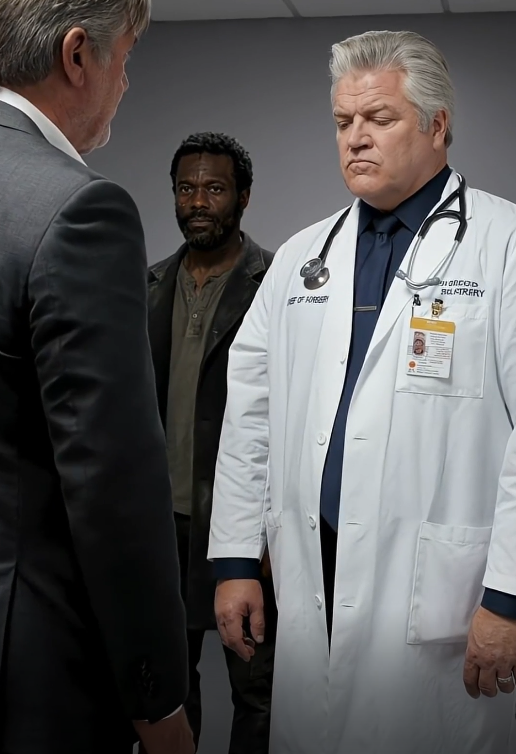
“Get out. This room has an iq minimum, and you clearly do not meet it,” professor Whittaker snapped.
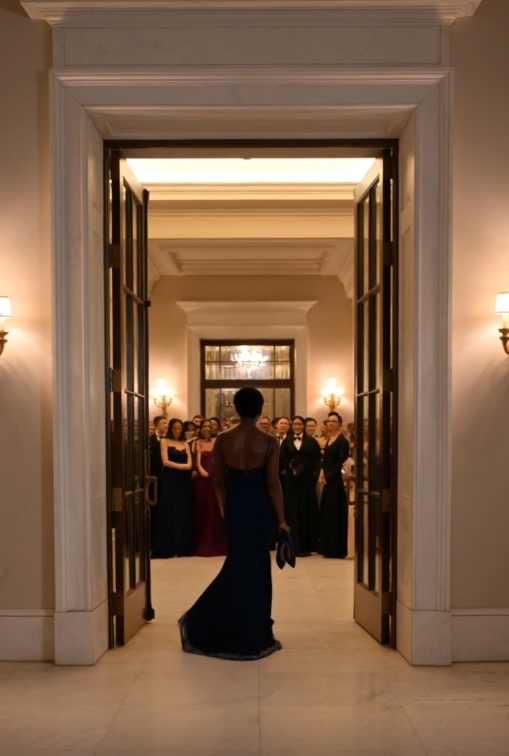
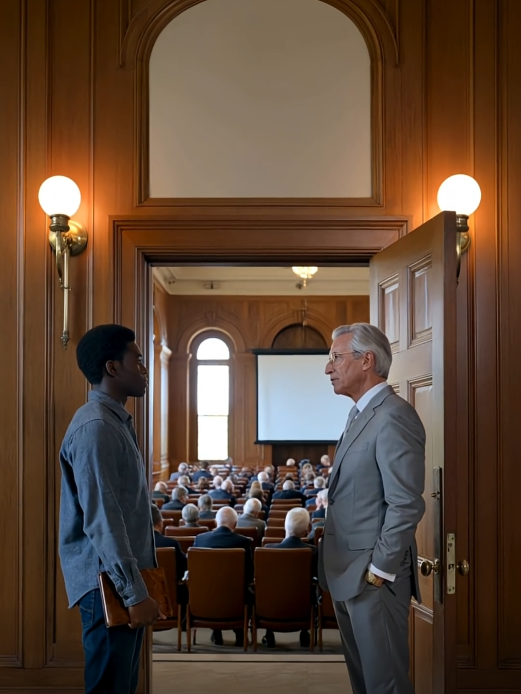
Wesley Davis stood quietly near the doorway, clutching an old leather notebook while thirty distinguished mathematicians watched him with amused expressions.
“I just want to listen, sir,” Wesley answered softly, refusing to lower his eyes despite the professor’s growing irritation.
“Listen? You can barely read. Security, who allowed this stray inside?” Whittaker sneered, pointing toward Wesley as several scholars laughed.
Wesley slowly opened his notebook and replied, “I read your paper, doctor Whittaker. All six of them.”
The laughter disappeared for a moment, but Whittaker smiled arrogantly. “Then you should know this room isn’t for boys from the gutter.”
“Sit down or get dragged out,” the professor warned. Wesley nodded politely and whispered, “Yes, sir, but your lemma 4.2 is wrong.”
The enormous hall suddenly fell silent. Thirty phd mathematicians stared at the twenty-year-old in a worn flannel shirt.
This was the Westbrook symposium, the most exclusive mathematics conference in the hemisphere, where reputations were built and careers were destroyed.
Behind Whittaker, the projector displayed the Caldwell-Rinehart conjecture, a legendary problem that had defeated brilliant minds for forty years.
Whittaker had devoted his entire career to that problem, publishing six papers and becoming famous for repeatedly approaching its impossible frontier.
Wesley, meanwhile, had traveled sixteen hours by Greyhound bus, carrying only two dollars and his grandfather’s battered leather notebook.
“You think you can challenge me?” Whittaker asked coldly. “Then prove your accusation, or leave my stage immediately.”
Wesley looked at the equations and calmly picked up the chalk. “All right, sir. I will show you exactly where it breaks.”
He did not write quickly. Every symbol appeared carefully, precisely, following methods his grandfather had taught him during countless nights.
Twelve minutes passed, and the laughter stopped. Twenty minutes later, mathematicians in the front row began copying Wesley’s equations.
Then professor Brooks suddenly stood and pointed toward line thirty-eight. “There’s a sign error. Amateur mistake. He’s finished.”
Wesley stared at the equation, smiled faintly, and said, “No, professor. That mistake is exactly what closes the proof.”
He transformed the disputed sign into a crucial condition, connecting two seemingly unrelated sections of the argument.
Margaret Caldwell, granddaughter of the conjecture’s original creator, suddenly stood from her seat and whispered, “Oh my god. He’s not fixing it. He’s using it.”
The room became completely still as Wesley continued writing, his hand steady while decades of mathematical assumptions collapsed around him.
Eighteen minutes later, Wesley stepped backward and placed the chalk down. Three letters remained on the board: q.e.d.
Nobody applauded immediately. Thirty renowned mathematicians simply stared at the completed proof, unable to process what they had witnessed.
Whittaker slowly approached the board, reading every line twice before his confident expression disappeared completely.
“Where did you learn this?” he finally asked, his voice trembling.
“My grandfather,” Wesley replied. “Walter Davis. He spent thirty years working on this inside a small toolshed.”
Whittaker looked confused until Wesley added, “They fired him from the railroad because of the color of his skin.”
For several seconds, nobody spoke. Then Margaret Caldwell covered her mouth, realizing Wesley had completed the work his grandfather never received recognition for.
Suddenly, the symposium’s live broadcast interrupted the silence. A Princeton representative appeared onscreen and said, “Mr. Davis, would you accept our invitation to continue this research?”
Wesley looked toward his grandfather’s notebook, smiled through tears, and answered, “Yes. But first, I want my grandfather’s name written beside mine.”
That night, the world celebrated a young genius, but Wesley remembered something more important: his grandfather had never failed.
He had simply been denied the chance to finish. And now, forty years later, his unfinished dream finally had an answer.